
Filter Cartridges in Food and Pharmaceutical Dust Control: HEPA-Level Efficiency Without Cross-Contamination
Introduction
Quality assurance managers, process engineers, and EHS specialists in food and pharmaceutical manufacturing plants must maintain strict hygiene standards while controlling fine, often organic or powdery dust from mixing, milling, drying, coating, and packaging operations. Any risk of cross-contamination, fiber shedding, or microbial growth in dust collectors can lead to product recalls, regulatory violations (e.g., FDA, EU GMP, or Halal/Kosher requirements), and production halts. HEPA-level pleated filter cartridges with non-shedding, washable, or sealed designs provide high-efficiency capture without introducing contaminants. This article offers a practical guide to filter cartridges for food and pharmaceutical dust control, covering media requirements, performance benefits, real results, and selection best practices to ensure product safety and compliance.
HEPA-Level Filter Cartridges for Food & Pharmaceutical Dust Control
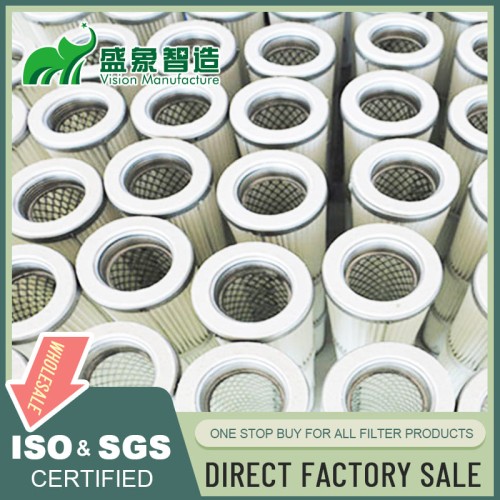
Food and pharma processes generate fine, light, and sometimes sticky dust (e.g., starch, lactose, active pharmaceutical ingredients, excipients) that must be captured at >99.97% efficiency for particles ≥0.3 μm without risking fiber release or microbial harboring. HEPA-level pleated cartridges (typically MERV 16–17 or true HEPA-rated) use synthetic media with sealed edges and non-shedding construction to prevent contamination. These cartridges suit pulse-jet or reverse-air collectors in cleanroom-adjacent or enclosed systems, maintaining product purity while supporting GMP and HACCP requirements.
Key Properties of Cartridges for Contamination-Sensitive Applications
Cartridges in food and pharma must prioritize safety, cleanability, and efficiency. Critical characteristics include:
- HEPA-Level Efficiency: MERV 16–17 or HEPA (≥99.97% at 0.3 μm) capture for fine powders and bioaerosols without breakthrough.
- Non-Shedding Media: 100% synthetic (polyester, polypropylene, or PTFE) with thermally bonded construction eliminates fiber release risk.
- Contamination Prevention: Sealed pleats, closed-end caps, and smooth surfaces prevent dust migration or microbial growth; FDA-compliant or pharma-grade materials available.
- Excellent Dust Release: PTFE membrane or nanofiber layers ensure easy cake dislodgement, minimizing residual dust and cleaning frequency.
- Washable & Reusable Options: Some designs allow water/IPA cleaning or sterilization without degradation, reducing waste in batch processes.
- Chemical & Temperature Compatibility: Resist sanitizers, moderate heat (up to 80–120°C), and pH extremes common in food/pharma dust streams.
In contamination-sensitive environments, these properties support zero-tolerance policies while delivering low total cost of ownership.
Applications in Food & Pharmaceutical Manufacturing
Cartridge collectors are widely used in food (flour milling, sugar handling, spice blending) and pharma (tablet coating, API drying, powder filling) for capturing dust at mixers, dryers, sifters, and packaging lines. HEPA-level designs ensure no cross-contamination between batches or product lines, supporting GMP Annex 1, FDA 21 CFR, and ISO 14644 cleanroom-adjacent requirements. They fit compact systems in clean facilities where space is limited and hygiene is paramount.
Real-World Case Example
A pharmaceutical tablet manufacturing plant in an emerging market operated pulse-jet cartridge collectors on coating and drying lines. Standard cartridges released minor fibers and allowed occasional fine particle breakthrough, risking product contamination and audit findings. Differential pressure rose quickly from sticky excipient dust, requiring frequent change-outs every 6–9 months.
The facility upgraded to HEPA-rated, PTFE membrane-laminated, non-shedding polyester cartridges. Results:
- Filtration efficiency reached 99.99% at 0.3 μm with zero fiber shedding.
- Cartridge life extended to 18–22 months.
- Differential pressure stabilized 40–50% lower.
- Pulse frequency reduced by 55%.
- Annual savings approximately $72,000 in replacements, cleaning, and audit risk mitigation.
- No contamination incidents; full GMP compliance maintained.
Recent Industry Context
The global industrial dust collector market is projected to grow at a CAGR of 5.0–5.4% from 2025 to 2030, according to 2025 reports from Grand View Research, Mordor Intelligence, and ResearchAndMarkets, with food and pharmaceutical sectors driving demand for contamination-free, high-efficiency systems. Stricter GMP and FDA guidance on dust control in 2025–2026 emphasizes non-shedding media and HEPA-level capture to prevent cross-contamination and ensure product integrity in clean manufacturing.
Practical Recommendations
To select and implement HEPA-level cartridges in food/pharma dust control:
- Define contamination requirements: Review product sensitivity, GMP class, and dust type (sticky/fine/organic) to select media (PTFE for release, non-shedding synthetic base).
- Choose certified options: Use FDA-compliant or pharma-grade cartridges with validation documentation for fiber release and extractables.
- Optimize cleaning: Use clean-on-demand pulsing (ΔP-triggered) at 70–90 psi to minimize media stress and dust re-entrainment.
- Monitor & validate: Install digital ΔP gauges and periodic particle counters; conduct integrity testing (e.g., DOP/PAO) annually.
- Integrate hygiene: Enclose systems, use stainless steel housings, and schedule wet cleaning/sterilization per SOPs.
- For distributors: Stock HEPA-rated, non-shedding cartridges and provide validation support for food/pharma clients.
HEPA-level filter cartridges enable safe, contamination-free dust control in food and pharmaceutical manufacturing. For media validation or system audits, consult specialized filtration engineers.
About the Author
Written by: Industrial Filtration Application Engineer
10+ years supporting dust collection upgrades in cement, steel, mining, incineration, and aluminum smelting plants across the Middle East, Africa, Indonesia, Vietnam, and Russia.