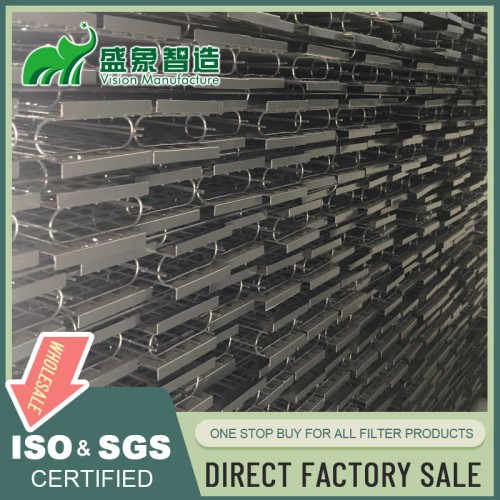

Filter Cage Design and Material Selection: Preventing Collapse in High-Vibration Steel Mill Environments
Introduction
Maintenance engineers and operations managers in steel mills frequently encounter premature filter bag failures due to excessive vibration from rolling mills, conveyors, and heavy machinery. This mechanical stress causes filter cages to deform, leading to bag abrasion against cage wires, uneven cleaning, accelerated wear, and eventual collapse during pulse cleaning cycles. Proper filter cage design and material selection are critical to maintaining bag shape, ensuring consistent airflow distribution, and extending system reliability in these vibration-intensive environments. This article provides a practical guide to filter cage specifications for steel mill baghouses, covering design factors, material choices, common failure modes, and proven performance improvements.
Filter Cage Design for High-Vibration Steel Mill Baghouses
Steel mills generate intense mechanical vibration that transmits through baghouse structures, stressing filter cages and causing them to bend, dent, or lose rigidity. Filter bag cages must withstand these forces while supporting the bag fabric under repeated pressure fluctuations and cleaning pulses. Key design elements include wire gauge, ring spacing, vertical stringer count, and construction quality to prevent collapse and minimize bag-to-cage contact wear in vibration-prone steel production areas.
Key Factors in Filter Cage Design to Prevent Collapse
Effective filter cage design in heavy-vibration steel mill environments emphasizes structural rigidity and vibration resistance. Important considerations include:
- Wire Diameter and Strength: Select 3–5 mm diameter wires (thicker profiles for severe vibration) to enhance bending resistance and maintain shape under cyclic loading.
- Ring Spacing: Opt for closer spacing (4–6 inches) to provide uniform support and prevent bag sagging or pancaking during cleaning; wider spacing increases collapse risk in high-vibration zones.
- Vertical Stringer Count: Use 12–20 stringers (higher counts for extreme vibration) to distribute mechanical stress evenly and reduce localized deformation.
- Top and Bottom Construction: Incorporate reinforced venturi tops and secure welded or interlocked bottoms to improve stability and prevent detachment.
- Material Selection: Choose galvanized carbon steel for standard use; stainless steel (304/316) for corrosion-prone areas; epoxy-coated variants offer additional vibration damping and protection.
- Two-Piece or Twist-Lock Designs: Facilitate easier installation in confined plenums and reduce stress concentrations in vibrating setups.
These design choices significantly mitigate vibration-induced collapse risks while supporting efficient dust cake release and low differential pressure. In vibration-intensive steel mills, upgrading cage design often delivers faster ROI than frequent media changes alone.
Applications of Filter Cages in High-Vibration Steel Mill Baghouses
Steel mills use baghouses to capture fumes from electric arc furnaces, sintering lines, rolling mills, and material handling systems. High-vibration zones near rolling stands or crushers require cages that maintain taut bag support without amplifying movement. Pulse-jet systems predominate in these applications, where robust cages prevent bag collapse during high-pressure cleaning pulses. Optimized cage selection reduces bag abrasion, extends media life, and helps maintain compliance with particulate emission limits in steel production.
Real-World Case Example
A steel rolling mill in an emerging industrial region operated pulse-jet baghouses collecting scale and fume dust. Standard galvanized cages with 8-inch ring spacing and 10 stringers deformed under continuous vibration from rolling equipment, causing bags to chafe and fail after 10–12 months. Differential pressure rose sharply due to uneven cleaning, and frequent bag replacements increased downtime.
The plant upgraded to custom stainless steel cages with 4-inch ring spacing, 16 stringers, and epoxy coating for enhanced damping. Results:
- Filter cage rigidity maintained, eliminating collapse incidents.
- Bag life extended from 10–12 months to 26–30 months.
- Differential pressure stabilized 35–45% lower.
- Annual savings approximately $80,000 in bags, labor, and reduced downtime.
- Emission levels remained consistently below regulatory thresholds.
Recent Industry Context
The global industrial dust collector market is projected to grow at a CAGR of approximately 5.0–5.4% from 2025 to 2030, according to 2025 reports from sources including Grand View Research and Mordor Intelligence, driven by stricter emission controls and system upgrades in heavy industries like steel production. In steel mills, vibration-related cage failures remain a persistent challenge, prompting greater adoption of reinforced designs and corrosion-resistant materials to improve reliability and reduce maintenance costs.
Practical Recommendations
To select and implement effective filter cages in vibration-prone steel mills:
- Assess vibration levels: Measure frequency and amplitude at the baghouse to determine required cage reinforcement.
- Match design to bag media: Use higher stringer counts and closer ring spacing for lighter felts; thicker wires for heavier fabrics.
- Choose materials wisely: Select stainless steel or coated galvanized in humid or corrosive steel mill atmospheres.
- Inspect regularly: Check for dents, bends (>5 mm/m), or coating damage every 6–12 months; replace deformed cages promptly.
- Combine with system tweaks: Ensure proper pulse pressure (90–110 psi) to avoid excessive cage stress during cleaning.
- For distributors: Stock reinforced cage variants (e.g., 12–20 stringers, 4–6 inch spacing) and offer custom fabrication for steel mill retrofits.
Optimized filter cage design significantly reduces collapse risks and extends bag life in high-vibration steel mill environments. For site-specific evaluations or custom cage specifications, consult experienced filtration specialists.
About the Author
Written by: Industrial Filtration Application Engineer
10+ years supporting dust collection upgrades in cement, steel, mining, incineration, and aluminum smelting plants across the Middle East, Africa, Indonesia, Vietnam, and Russia.